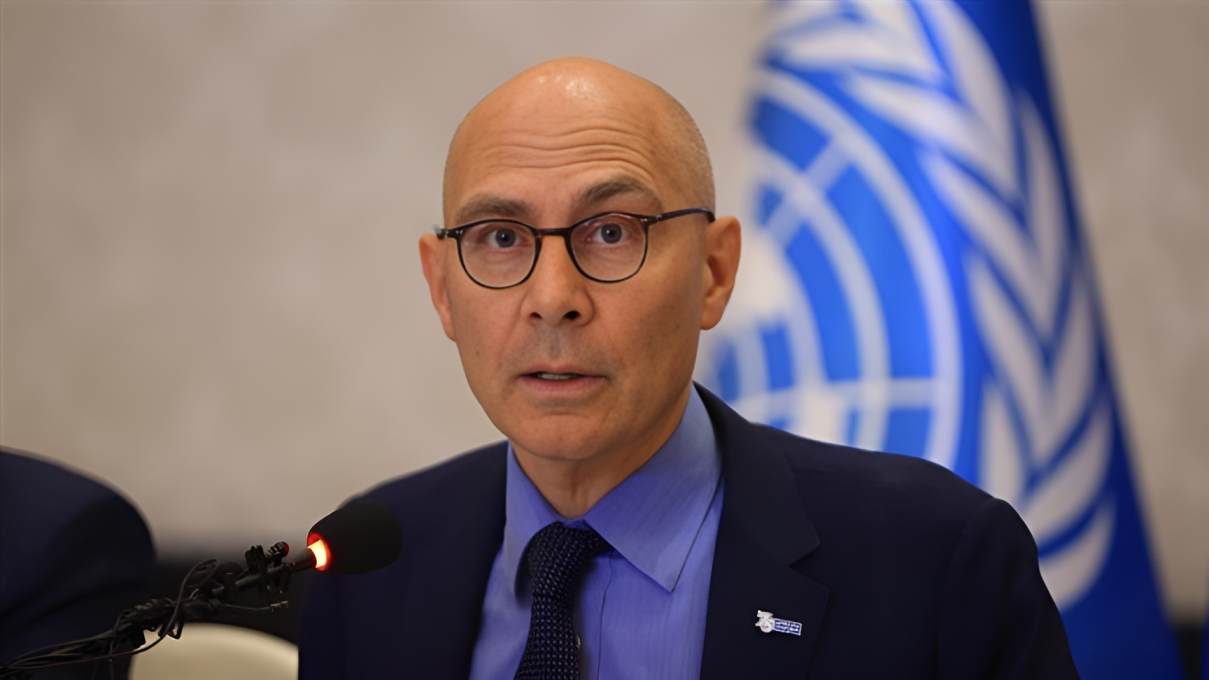
The UN human rights system is facing deep strain as global crises rise faster than available resources, UN Human Rights Chief Volker Türk has warned while launching a Sh51.6 billion funding appeal for 2026.
Speaking on Thursday during the launch, Türk said the Office of the UN High Commissioner for Human Rights is struggling to respond to conflict, inequality and instability due to chronic underfunding that has already reduced staff, cut monitoring work and weakened protection for vulnerable communities.
He cautioned that the timing could not be worse.
“With mounting crises, the world cannot afford a human rights system in crisis,” he said, adding, “The cost of our work is low, the human cost of under-investment is immeasurable.”
Türk described the Human Rights Office as a critical presence for people facing abuse in both conflict and non-conflict settings.
“In times of conflict and in times of peace, we are a lifeline for the abused, a megaphone for the silenced, a steadfast ally to those who risk everything to defend the rights of others,” he told member states.
Despite limited resources, the Office carried out extensive work in 2025. Its staff operated in 87 countries, monitored more than 1,300 trials, supported 67,000 survivors of torture, documented tens of thousands of human rights violations, and helped secure the release of more than 4,000 people held in arbitrary detention.
Türk stressed that human rights are closely tied to economic stability and peace, saying social and economic rights are key to reducing inequality.
“Human rights make economies work for everyone, rather than deepening exclusion and breeding instability,” he said.
During 2025, the Office worked with over 35 governments on what it called the “human rights economy”, an approach that aims to align economic decisions with human rights standards.
In Djibouti, the Office supported a human rights review of the national health budget, with special focus on people with disabilities. It also provided human rights analysis to several UN Country Teams involved in sustainable development planning.
However, Türk warned that funding shortages are already affecting operations. Human rights monitoring missions dropped sharply to 5,000 in 2025, compared to 11,000 the previous year.
Several country programmes faced heavy cuts. Operations in Myanmar were reduced by more than 60 percent. In Honduras, work supporting prison demilitarisation and justice and security sector reforms was scaled down. In Chad, advocacy and legal support for nearly 600 people held without legal basis had to be stopped completely.
“Our reporting provides credible information on atrocities and human rights trends at a time when truth is being eroded by disinformation and censorship,” Türk said.
He noted that this reporting feeds into discussions at the UN Security Council and the Human Rights Council and is often used by international courts as evidence in accountability processes.
The broader UN human rights system has also been affected by the organisation’s liquidity crisis. As a result, 35 scheduled state party dialogues under UN Human Rights Treaty Bodies did not take place.
Four of eight planned country visits by the Sub-Committee on Prevention of Torture were cancelled, while UN Special Rapporteurs faced limits on their ability to carry out visits. Investigative bodies under the Human Rights Council were also unable to fully deliver on their mandates.
Türk said the Office lost about 300 staff from a workforce of 2,000 and had to close or sharply reduce operations in 17 countries, including Colombia, Guinea-Bissau and Tajikistan.
“All this is weakening our ‘Protection by Presence’,” he said, referring to the deterrent effect created by having trained human rights officers on the ground.
On the financial side, Türk said the Office faced a major funding gap in 2025. While its approved regular budget was higher, it received only Sh31.73 billion, leaving a shortfall of Sh7.03 billion.
Voluntary funding also fell short. Of the Sh64.5 billion requested, only Sh33.29 billion was received.
Looking ahead to 2026, Türk said the UN General Assembly has approved a regular budget of Sh28.92 billion, based on assessed contributions. This represents a 10 percent cut from 2025, with further uncertainty linked to the ongoing liquidity crisis.
He thanked 113 funding partners who supported the Office in 2025 but said the current level of support is not enough.
“Historically, human rights account for an extremely small portion of all UN spending,” he said. “We need to step up support for this low-cost, high-impact work that helps stabilise communities, builds trust in institutions, and supports lasting peace.”































Comments
Sign in with Google to comment, reply, and like comments.
Continue with Google